Paper MoonSTORIES

Adult historical fiction · Suleiman Hussein

The House
of Paper.

A world to discover.
An ambition to reckon with.

Baghdad, 787. A tilemaker’s son leaves the city for the first time, carrying his master’s paper into a world of merchants, strangers and opportunity. He has much to learn about trade. He has still more to learn about trust.

Planned UK Kindle price £4.99 · By Suleiman Hussein

787–793The Abbasid world30 chaptersA substantial novelFor adultsHistorical fiction
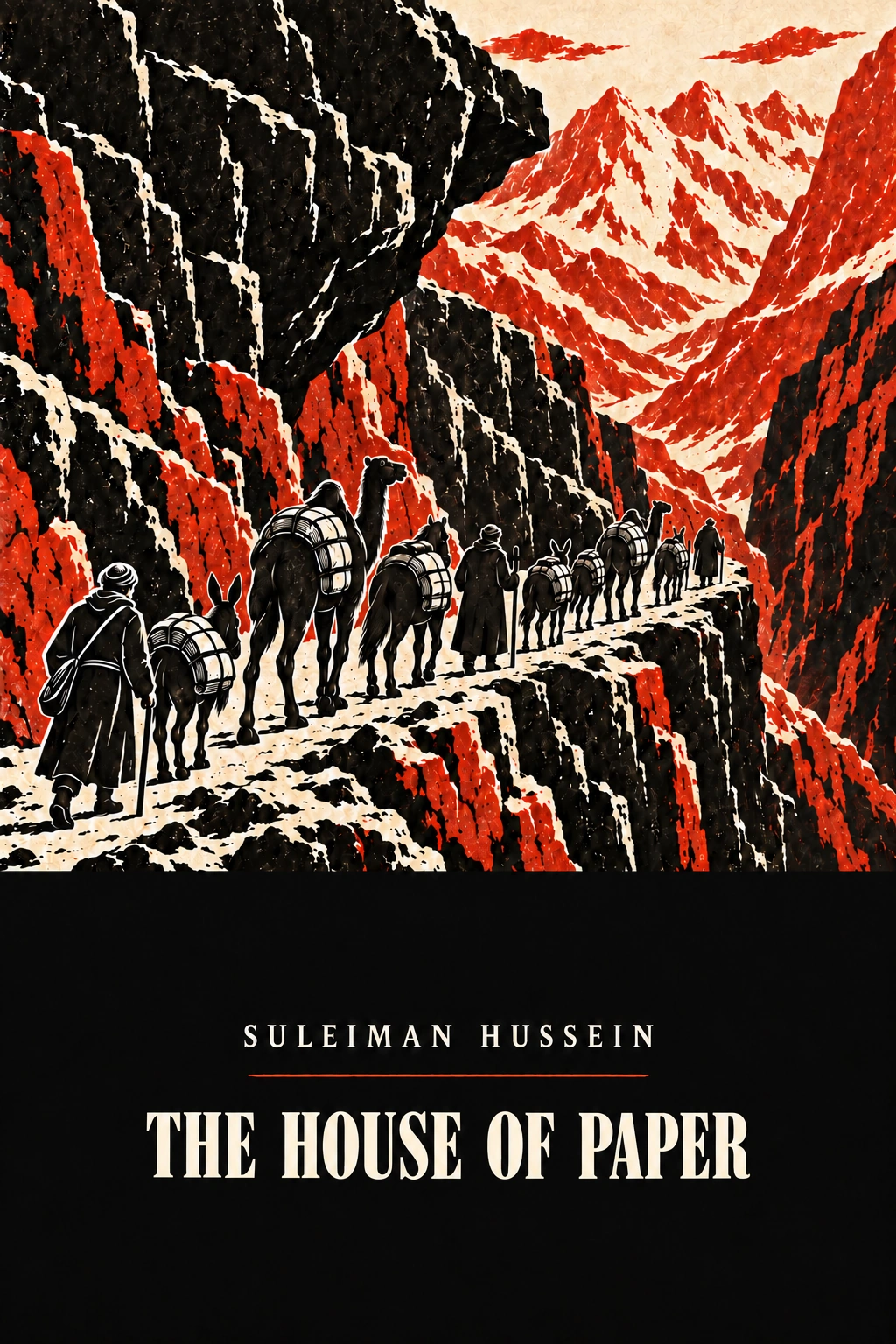
Official cover of The House of Paper by Suleiman Hussein: a mountain caravan in black and red above a black title panel.

A novel by Suleiman Hussein

01 / The world

Come into a city
that is making itself.

Along the Tigris, among the workshops and market stalls, a young man begins to see how far a sheet of paper might travel.

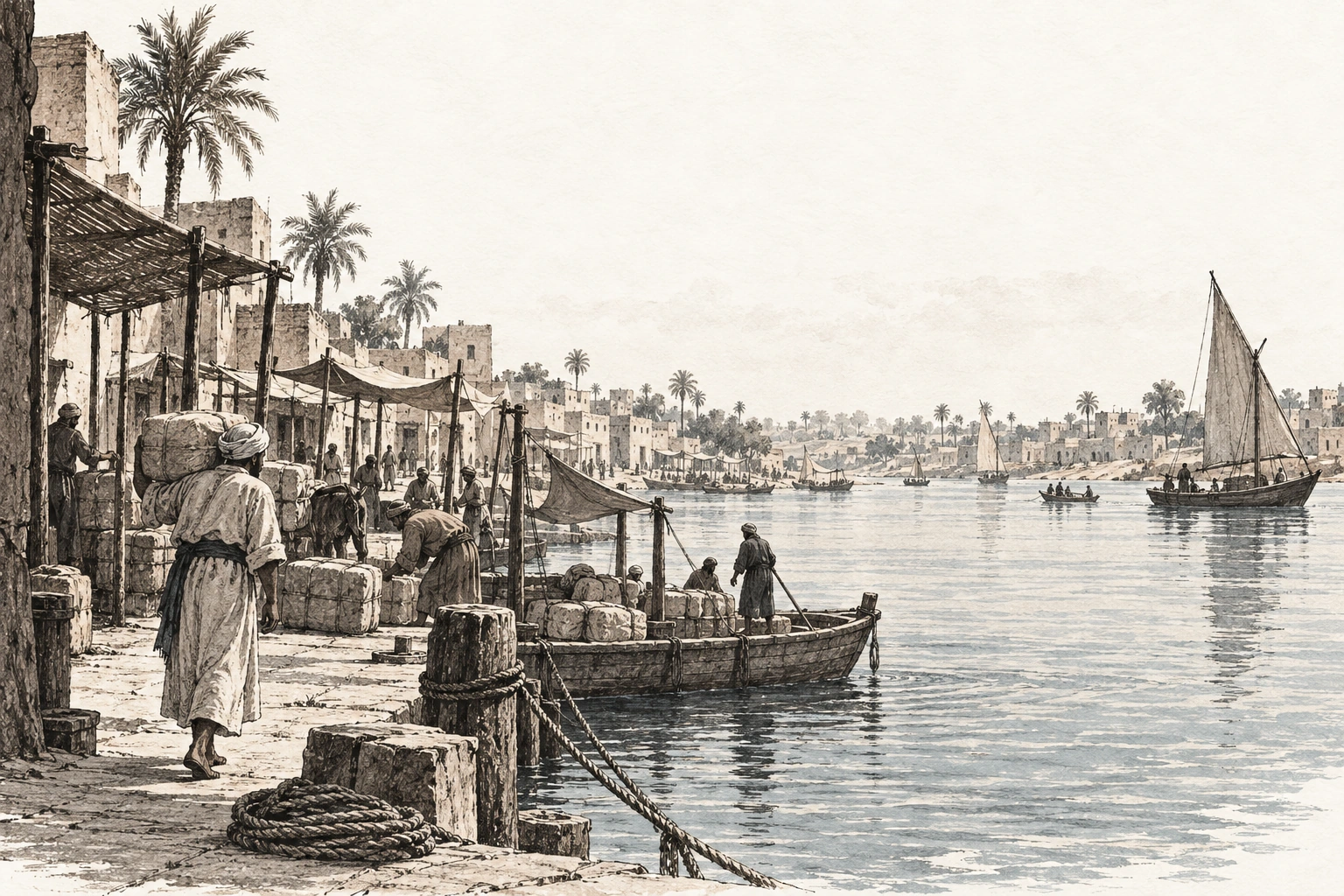
Fine ink illustration of porters, cargo boats and low riverbank buildings beside the Tigris.
Baghdad, a city in motionView illustration

Baghdad is home before it is a destination. Khalid knows its workrooms, familiar lanes and evening sounds. He knows the labour hidden inside an ordinary object: the care that makes a tile hold its colour, the patience that gives paper a surface fit for a reed pen. But there are parts of the city he is only beginning to understand. A customer’s complaint, a government order or a stranger’s promise can open a door into a different world.

The novel follows him into that wider city. Cloth must be kept dry. Paper must be judged by the people who use it. A sale is unfinished until payment arrives. In the space between a good bargain and a kept promise, Khalid discovers that commerce is as much about people as it is about goods. Baghdad offers him room to grow—and more than one way to misunderstand what growth means.

The history behind the setting

Founded in 762 as the Abbasid capital, Baghdad became a major centre of political, commercial and cultural life. The novel opens a generation later. Its workshops and trading relationships bring that setting close to the ground, through fictional lives rather than a tour of famous monuments. Little of early Abbasid Baghdad survives; the illustrations on this page are imaginative interpretations.

Explore the Abbasid period at The Met

02 / The story

Seventeen.
Beyond the gates.
Not quite ready.

Until this morning, Khalid has never slept outside Baghdad’s walls.

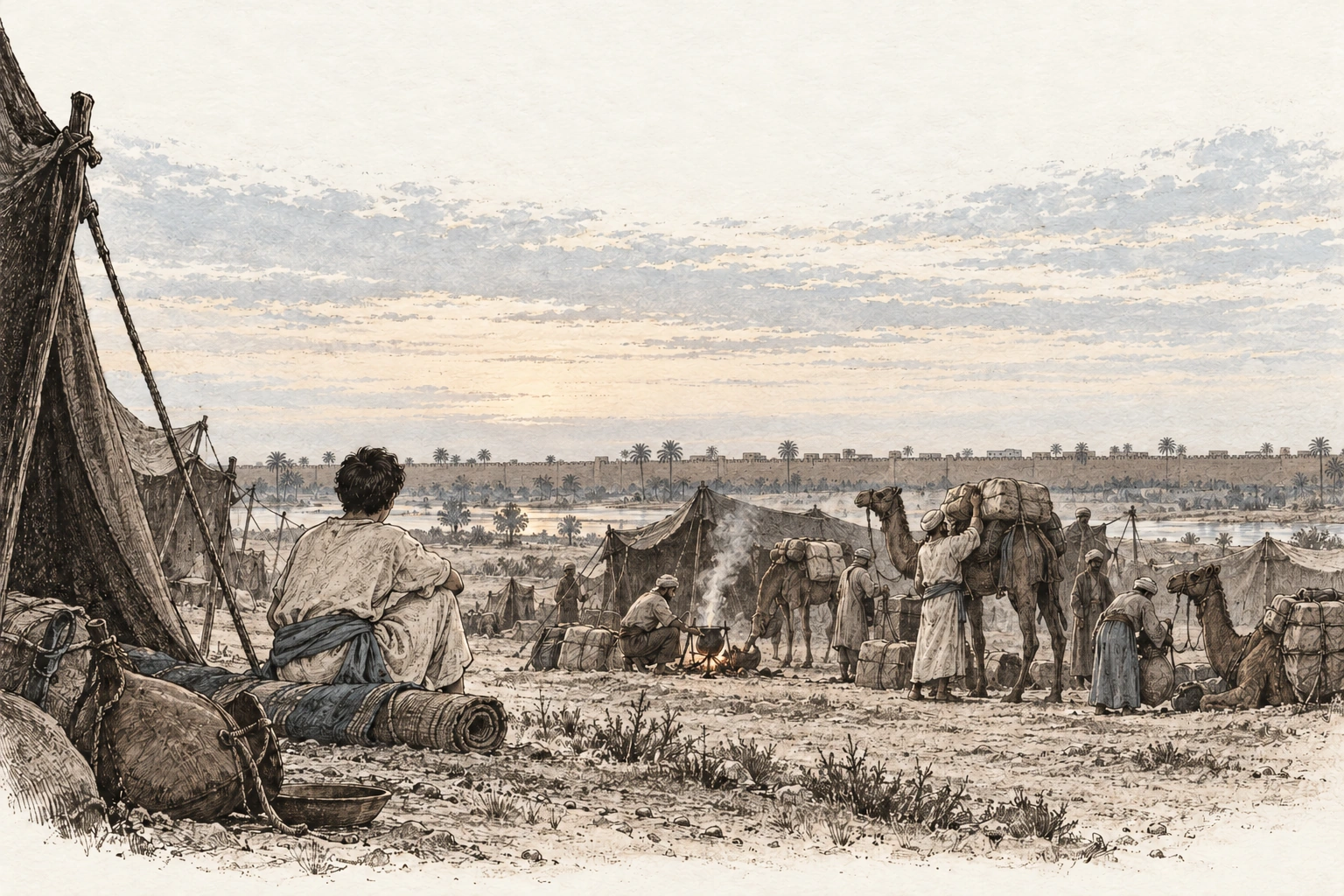
Now he is in a caravan camp, surrounded by travellers whose accents and destinations stretch far beyond anything he has known. The camels are complaining. The cook fires are waking. His teacher, Ustad Umar, is already moving with the certainty of a man who knows what the day will demand.

Khalid has samples to protect, unfamiliar food to navigate and the awkward confidence of someone who has imagined the journey more often than he has prepared for it. He expects to sell paper in Kufa and return with a story worth telling. The road quickly begins an education of its own.

Across six years, his world widens through journeys, work and encounters that refuse to fit his first impressions. He is observant, quick to learn and increasingly alive to possibility. Those gifts make him an engaging companion. They also leave him dangerously willing to believe that seeing an opening means he should take it.

Begin where his journey begins
A young apprentice sits beside his blanket while camel handlers prepare a caravan in the pale dawn outside a low city wall.
Before the first departureView

03 / The craft

Before it carries a word,
a sheet carries work.

Water, fibre, heat and patience. The material at the heart of the story has a life of its own.

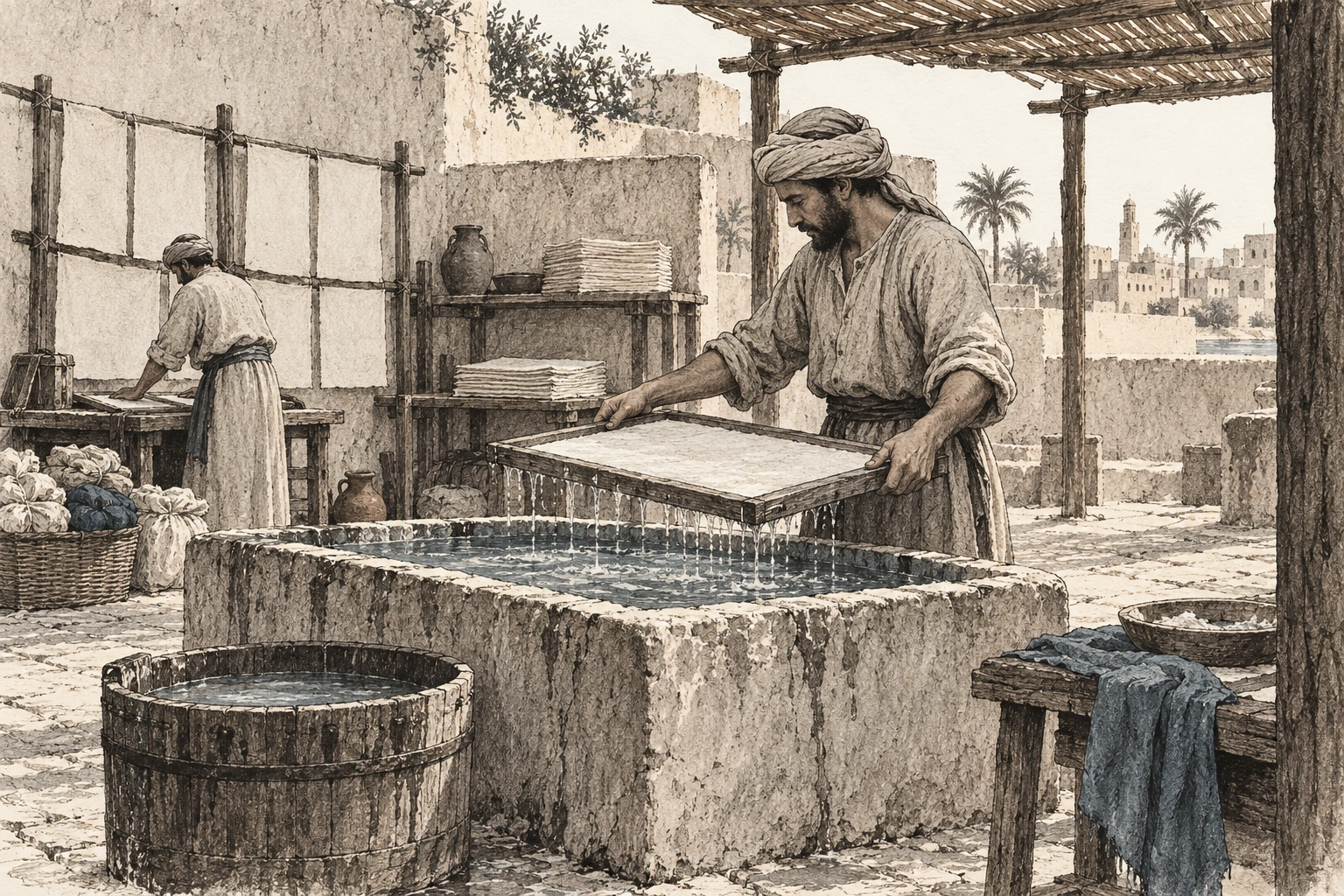
A papermaker lifts a reed-screen mould from a vat as another worker tends paper in a shaded courtyard.
The work behind a sheet of paperView illustration

In Abu Said’s workshop, excellence is something the hands must learn. An apprentice can repeat a measurement without understanding it. A craftsman must notice when the water, the heat or the mixture demands attention. Khalid’s education takes place among the smells of soaked linen and starch, the sounds of work and the small decisions that separate a reliable sheet from one that disappoints its buyer.

The finished paper must survive a second education outside the workshop. Its quality will be tested by copyists, merchants and officials with different needs. A fine sample cannot excuse a damaged delivery. A carefully prepared surface still depends on the cloth around it, the load beside it and the person responsible for bringing it safely through the rain. Craft and commerce meet long before anyone agrees a price.

  1. 01

    The material

    Fibres and water begin the work. The apparent simplicity of a sheet conceals preparation and skill.

  2. 02

    The surface

    Sizing and finishing help prepare paper for ink. The workshop’s standards matter in every batch.

  3. 03

    The promise

    A buyer trusts the sample, the delivery and the maker’s word. A good sheet is only part of the agreement.

Historical background: papermaking traditions varied across time and place; forming, drying, sizing and burnishing were important parts of the craft. This is a literary introduction, rather than a dated technical reconstruction. Read conservator Helen Loveday’s account

04 / The people

The people who teach him
what a thing is worth.

Masters, friends and family. Each has a life beyond the part Khalid imagines they should play in his.

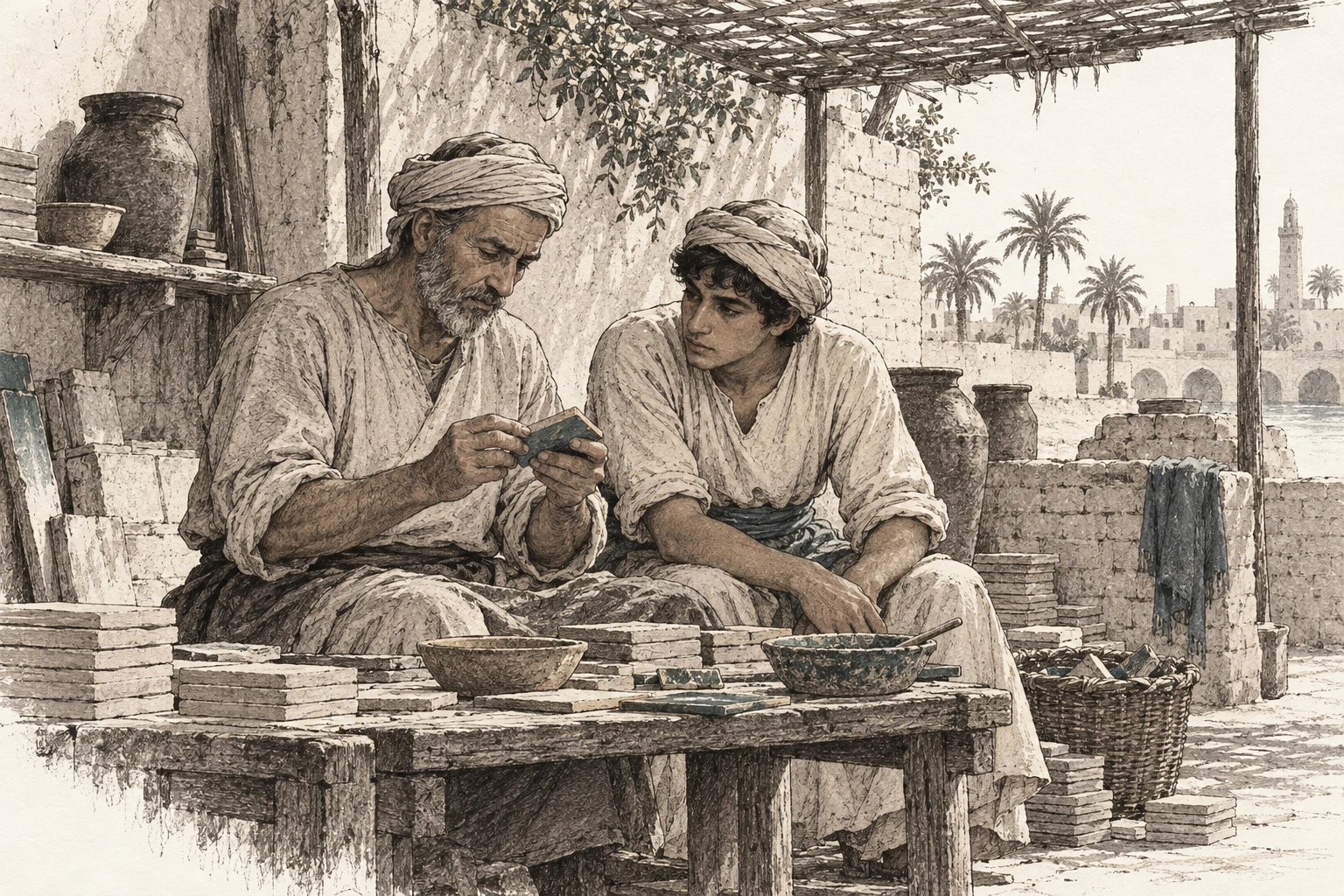
An older tilemaker and his late-teen son share a quiet moment examining a small tile at a workbench.
A father’s craftView illustration

The father

Ali

A tilemaker whose affection is often practical: a place beside him, a meal, attention to something his son has brought home. Khalid knows the value of his father’s skill. Understanding the shape of his life is harder. Their relationship gives the novel its most intimate question: how do you reach for a larger world without making the people who raised you feel small?

The master

Abu Said

The papermaker’s standards cannot be satisfied by enthusiasm alone. He gives Khalid work that requires care, judgement and eventually responsibility. Under his roof, skill becomes something exacting and trust something specific. Wanting to please a master is easier than learning what his confidence actually asks of you.

The road teacher

Ustad Umar

Experienced, economical with words and difficult to impress, Umar knows that a lesson heard at home may mean little on the road. He lets Khalid encounter the difference between having an answer and understanding a problem. His corrections can be uncomfortable. They are rarely wasted.

The friends

Musa & Omar

Musa brings music, companionship and interests that cannot be reduced to a profitable use. Omar al-Dimashqi brings the steadiness of a craftsman who cares about making the work good. Together they give Khalid something ambition cannot manufacture: other people’s freely offered company, and their right to choose for themselves.

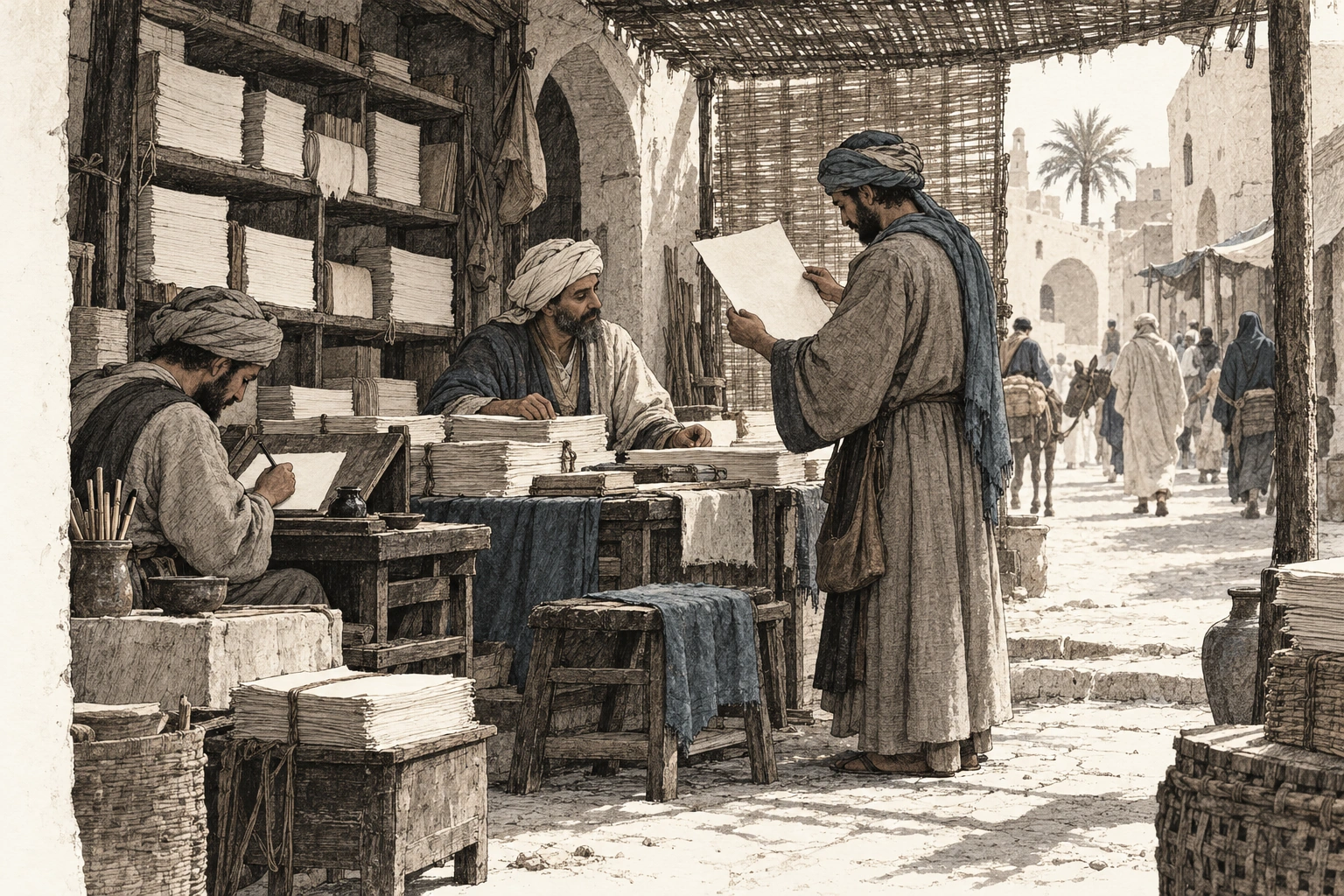
A customer inspects a handmade sheet while a merchant and copyist work among stacks of paper under a woven shade.
Among the paper sellersView

05 / The market

A price is a number.
Value is a conversation.

In the paper market, a sheet passes from one pair of hands to another. Someone notices its finish. Someone questions its grade. Someone wants credit. Khalid must learn to hear what a customer is asking for, rather than simply describe what he has brought.

The novel finds tension in these ordinary transactions. An order can carry hope, uncertainty and obligations that outlast the moment it is placed. A written name matters only if another person will honour it. The route between a promise and its fulfilment may be longer than the road between two cities.

Against this fictional trading life sits a larger historical change. Paper helped support the growth of books and written exchange in the Islamic world. Baghdad’s multilingual scholarly culture also brought texts and ideas across linguistic boundaries. The novel approaches that world through the people who make, carry, sell and use the material.

Baghdad, paper and the world of books · British Library

06 / The journeys

The world is larger
than his first idea of it.

Dust and river damp. Mountain paths and courtyard water. Each journey changes what Khalid notices.

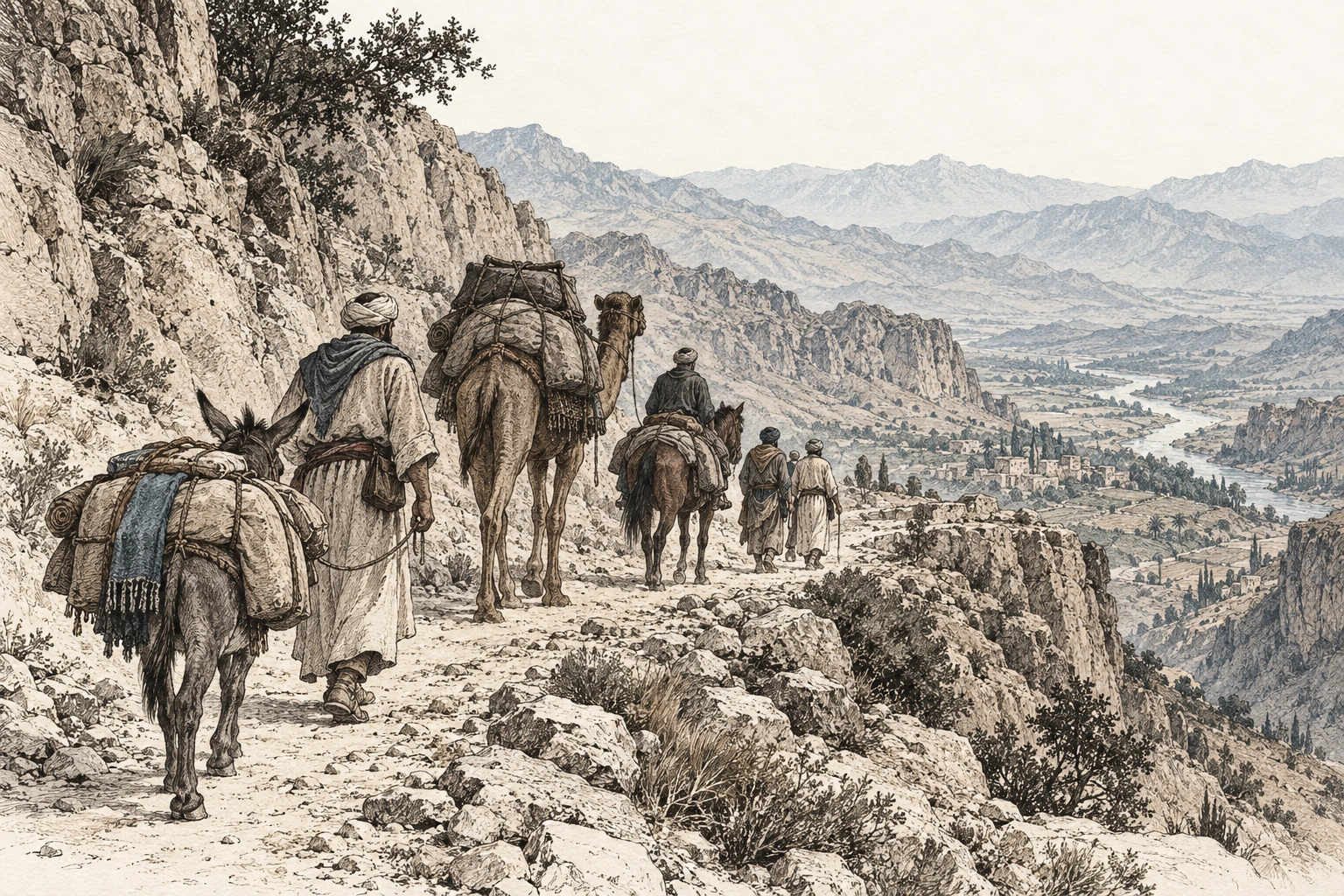
A donkey, camel, horse and their travellers follow a rocky mountain track above a distant valley, drawn in fine ink.
The road through the ZagrosView illustration

Kufa

The first journey

Before he has found his feet as a trader, Khalid must find his place among experienced travellers. The journey to Kufa turns certainty into questions, and a sample of paper into a responsibility he can feel in his hands.

The Zagros & Rayy

Across the heights

The eastern road brings difficult ground, freight that must arrive intact and encounters beyond the reach of familiar workshop rules. In Rayy, what Khalid observes about trade opens new questions about money and a person’s word.

Damascus

A different abundance

After the demands of the western road, running water has a force of its own. The city offers courtyards, new households and conversations that widen the story beyond the business Khalid thought had brought him there.

The novel’s wider world also reaches Mosul and Merv. These are places in Khalid’s story; the sequence above introduces selected journeys rather than presenting a complete route map.

07 / What stays with you

What if getting ahead
costs more than you counted?

Khalid’s story is driven by opportunity, but its stakes are personal. A father’s regard, a master’s confidence, a friend’s independence: none can be entered neatly into an account. He is learning to judge goods and read people at the same time, and the second skill does not always make him wiser.

The House of Paper is for readers who enjoy an inhabited historical world and a protagonist whose gifts complicate his life. Its pleasures are in conversation, shared work, uncomfortable choices and the slow discovery that an obligation remains an obligation even when another possibility looks brighter.

Spend a few pages in his world

08 / Begin reading

The Journey
to Kufa.

The opening of Chapter One, taken directly from the novel.

1,015 words · Opening excerpt

The ebook is a text-only novel. The illustrations on this page were created for its launch.

CHAPTER ONE

The Journey to Kufa

There are two kinds of silence. The first is the quiet of rest, of the world finished with its noise and settling down. That kind Khalid knew well. The paper workshop at the end of a long day, the vats stilled, the drying frames empty, his master's voice gone hoarse and finally, mercifully, stopped.

This was the other kind.

The pre-dawn cold of the caravan camp held a silence that waited. Vast and brittle, like a sheet of ice over deep water. Into it the world leaked: the snores and grunts of a thousand sleeping men, the shifting of animals in the dark, the low moan of wind across open ground. But the sky was enormous here, and it swallowed every sound before it could take hold.

Then the silence broke. The adhan rose from somewhere in the camp, thin and clear as a blade, and it launched the complaints. Not of men. Of camels. A deep, wet, protesting groan from a hundred throats, a sound like the earth itself objecting to the dawn. They were the ships of the desert, indispensable and prized, and they hated the morning.

A bubbling, liquid belch from the animal beside him jolted Khalid fully awake. He lay still, eyes half-open. Through his lashes he watched Ustad Umar rise from his mat, wrap his shawl tightly around his shoulders, and begin picking his way toward the prayer area. Khalid kept very still. If the ustad turned and saw his eyes open, there would be no escaping it---the cold water, the ablutions, the prayers. He had done his share of praying in Baghdad. God would understand.

Continue the opening excerptClose the extended excerpt

Umar did not turn. Khalid pulled the blanket over his head and breathed out.

What woke him next was the smell.

It came in layers. First the spices---cumin, then cardamom, then a sweetness that might have been dates in burned sugar. Then smoke, acacia wood, sharp and resinous. Then, beneath it all, cutting through the thick animal reek of the camp, the unmistakable smell of meat cooking in fat. His stomach answered before his mind did. He sat up.

All around him the camp was stirring. The great field outside Baghdad's Kufa Gate was filled with a city's worth of travellers, and now every one of them was doing the same thing: finishing whatever task was at hand and turning their face toward the cook fires. The biggest group were the Hajj pilgrims, hundreds of them, bound for the holy cities. They had come from every corner of the Caliph's empire---from Raqqa and Mosul, from Isfahan and Rayy, from the Khorasani cities Khalid knew only from his father's stories: Merv, Nishapur, Nasa. There were even men from Kabul who spoke their Arabic with a thick accent and prayed with their hands held differently. They had been talking last night of friends who had sailed from a port in Sindh whose name Khalid had never heard, in a land he could not quite imagine.

He was seventeen years old, and until this morning, he had never slept outside the walls of Baghdad.

He found Sayeed and Sa'dan already at work.

The two merchant's assistants were breaking down their master's tent with the practised efficiency of men who had done this a hundred times. Sa'dan, the elder, was directing the labourers on the right side, his voice low and precise. Sayeed, who was closer to Khalid's age, was overseeing the left, one eye on the fold and the other on Sa'dan, checking that he was doing it right. They worked without hurry, their hands quick, their conversation easy.

"You have to do this every morning?" Khalid asked, stepping up beside Sayeed. He already knew the answer. But he needed to say something, because he had been standing at the edge of their campsite for a full minute and the silence was becoming conspicuous.

"Almost every morning." Sayeed didn't look up. "Past Kufa, there are some bigger khans with rooms to rent. The master sleeps indoors. We sleep outside as always."

"That doesn't seem fair."

Sayeed shrugged. "I like the open sky. Camp life is good once you're used to it." He glanced at Khalid and grinned. "You'll see."

Sa'dan came around to check the left side. He was perhaps twenty, lean and weathered in a way that made him look older, with the kind of calm that comes from knowing exactly what to do at every moment of the day. He looked at Khalid briefly, took in the boy's shifting feet and the way his eyes kept drifting toward the cook fires, and smiled.

"Salaam, Khalid. Mirza can finish loading. I can see our little brother has a growling stomach. Let's go eat."

The cook fires were a world unto themselves.

A row of massive, blackened cauldrons balanced over smoky pits. Steam rose in thick, fragrant clouds, momentarily hiding the faces of the men who stirred them with paddles the size of oars. Around them pressed a mass of humanity---pilgrims in dust-grey travelling robes, their staffs and water skins gathered close, merchants in dyed wools arguing with porters, hard-faced caravan guards with scarred hands resting near the hilts of their swords. The noise was tremendous. Men shouting in half a dozen accents, haggling over portions, laughing sudden belly-laughs. All of it underscored by the hungry crackle of the fires.

Khalid spotted Ustad Umar already waiting in one of the long queues and moved to join him, but Sa'dan caught his shoulder.

"We do not cut in line. A rule of the caravan."

"I'm just going to---"

"Doesn't matter. Come with me. I know a fire that's less busy."

He moved through the crowd with a shuffling, practised gait, finding gaps where Khalid saw only a wall of bodies, turning his shoulders to slide through. Khalid and Sayeed followed in his wake. He led them to a smaller fire where the men ladling portions looked less harried.

"Two choices," Sa'dan said, pointing with his chin. "Harīsa you know. The other is Sikbāj. Too rich for a morning meal, but it's departure day. They always cook something special."

End of opening excerpt

Your next world to enter

The House of Paper

By Suleiman Hussein · Published by Paper Moon Stories

The House of Paper official cover

Kindle edition · Forthcoming

A story with room
to lose yourself in.

A complete adult historical novel, in thirty chapters, set in the Abbasid world between 787 and 793.

£4.99 Planned UK Kindle price

The Kindle edition is being prepared for release. An Amazon purchase link will appear here when it is available.

Read the opening
Who is this novel for?

This is adult historical fiction. It follows Khalid from seventeen into his early twenties, with a focus on craft, commerce, relationships and the consequences of ambition.

Is it an illustrated book?

The novel’s interior is text only. The ink illustrations on this webpage are original marketing artwork, created to evoke its setting and fictional characters.

Is the story historical or fictional?

Khalid and the central plot are fictional. The setting draws on the Abbasid world. Dialogue, personal encounters and the pictured scenes are imaginative storytelling; the illustrations are not surviving historical views or exact architectural reconstructions.

Can I buy it now?

The Kindle edition is forthcoming. The planned UK price is £4.99. Retail availability and the final local price will be shown on Amazon once the book is released.

Press Escape or use Close to return to the page.