
Paperback
£14.99
Choose paperback ↗A Trip in Time · Book Two · Ages 12–15
Paperback & hardbackSome holidays get complicated.
A family research trip. A magnificent city. A friend who disappears. Travel with fourteen-year-old Nora into the streets, courtyards and surprises of Islamic Spain.
£14.99
Choose paperback ↗£19.99
Choose hardback ↗Full-colour illustrated story · 170 × 244 mm.
Delivery options and costs are calculated at checkout.
The selected cover.
A new destination for Nora.
01 / A holiday in another century
Nora has plans for the extra day off. So does her American schoolfriend Zoe. Unfortunately, Nora’s dad has plans too—and his involve a research visit to a city that happens to be more than a thousand years in the past.
Ali calls it a small trip. He has a list of questions, a historian’s enthusiasm and a rather flexible idea of how much work fits into a holiday. Sara has scientific interests of her own, but she would also like time to meet people, make something and enjoy herself. Nora intends to find out what there is to do beyond listening to adults explain things.
Their destination is Córdoba, around AD 955, during the reign of Abd al-Rahman III. Across the river lies a city of busy workshops and shaded doorways, grand ambitions and ordinary errands. Beyond it rises Madinat al-Zahra, the caliph’s palace-city, where even a conversation can involve knowing where to stand and when to wait.
Maryam knows the turns, the households and the work that has to be done before anyone can go exploring. Idris knows another world: the careful manners and expectations of an envoy’s family. Together, the three teenagers find plenty to laugh about—and plenty they do not immediately understand about one another.
Then Idris disappears. What looks to the adults like a possible political crisis means something different to Nora. She knows her friend has run away. Finding him takes her, Maryam and the family through the city and beyond its familiar streets.
The question is no longer how much adventure Nora can fit into a holiday. It is how to bring a friend home without losing his trust. There is room for discovery and humour along the way, but listening properly may matter more than having the quickest answer.
02 / People to travel with
Nora, Sara and Ali are a Muslim Bengali family. Their curiosity, warmth and very different ideas about a good holiday travel with them. Each has a life and an interest beyond the central adventure.
Fourteen. Curious. Quite ready for a holiday.
Nora notices details, enjoys drawing and is quick to become interested in people. She can also decide what a situation means before she has heard all of it. In Córdoba, a new friendship gives her plenty to enjoy and a reason to reconsider what helping someone actually requires. She travels with questions, a sketchbook and an imperfect understanding of the people around her.
A scientist with time for an experiment of her own.
Sara is Nora’s mum. Her scientific work makes the family’s journeys possible, but being capable in one field does not make every new skill easy. Córdoba offers her practical questions, unfamiliar materials and the chance to learn from other people’s experience. She has her own interests and relationships throughout the holiday.
A historian with rather a lot to ask.
Ali is Nora’s dad. He has come to learn about how a great city is governed, and the prospect of speaking to people who help run it is difficult for him to resist. His excitement brings the past close. The trip also asks him to notice when the question he has prepared is less useful than the conversation in front of him.
For her, this extraordinary city is home.
Maryam is fourteen, practical, observant and quick to laugh. She has errands, household responsibilities and opinions of her own. She introduces Nora to a Córdoba that visitors can easily overlook: familiar people, working routines and the meaning of an apparently ordinary turning. Their friendship involves enjoyment, disagreement and learning to take each other seriously.
Fifteen. Polite company. A future being discussed.
Idris is the son of a visiting envoy. He can manage a formal introduction and sometimes make a simple purchase wonderfully elaborate. Beneath those manners is a teenager uncertain about what adults are arranging for him. Friendship offers a different kind of conversation, though saying what he needs does not always come easily.
03 / Al-Andalus, around AD 955
The novel visits al-Andalus, the name used for the Muslim-ruled territories of the Iberian Peninsula. Córdoba is its setting at a particular moment, around AD 955, rather than a mixture of everything that happened across many centuries of Islamic Spain.
Abd al-Rahman III proclaimed himself caliph in 929. During his reign, Córdoba was the centre of a powerful court, and the new palace-city of Madinat al-Zahra took shape nearby. Rulers, envoys and officials belong to this world; so do carriers, cooks, potters, sellers and the households making an ordinary day work.
Abd al-Rahman III proclaims the caliphate.
Madinat al-Zahra takes shape near Córdoba.
The fictional family visits the city.
Nora’s home life in London.
That difference in scale is part of the pleasure of the story. Ali can be fascinated by the workings of government while Nora is trying to follow a friend through a crowded lane. A grand building and a waiting customer both have something to tell them. The city is full of people whose attention is quite reasonably on their own business.
The historical setting supports an original fictional adventure. Nora’s family and friends are invented characters; their conversations and experiences are not presented as recovered historical records. The pictures imagine the city, while the real places and chronology provide a framework for discovery.
The Guadalquivir gives the family an approach to the city before they know its lanes. Traffic moves around them: people carrying goods, animals needing room and travellers who have a destination beyond admiring the view. Crossing into Córdoba is the beginning of learning how to be there.
Columns, arches, shade and light give the city’s great mosque a scale of its own. The setting belongs to the years before the famous later enlargement under al-Hakam II. The webpage illustration imagines an earlier hypostyle interior, rather than treating today’s monument as an unchanged view of AD 955.
Outside Córdoba, the caliph’s palace-city spreads across terraces at the foot of the hills. Its buildings express power and ambition, but visiting also involves roads, deliveries, workers, waiting and arrangements. Nora’s experience keeps those practical details beside the splendour.
A bowl has a maker. Bread takes work before it reaches a table. A seller has other customers waiting. The family discovers the city through these small encounters as well as its famous places. Crafts, food and conversation give the historical world a human texture.
04 / A promise between friends
A new friend can make an unfamiliar city feel full of possibilities. Maryam and Idris bring different knowledge, different responsibilities and different ways of speaking. Nora enjoys their company before she understands all the expectations around them.
Their days contain mistakes, jokes, stories and the pleasure of doing something together. Some misunderstandings are funny. Others leave somebody feeling that no one has listened. The adventure grows from those relationships, so what Nora does matters to people she has come to care about.
When Idris disappears, noticing a route or remembering a conversation is only part of the task. Nora has to think about promises, adult worries and a friend’s own wishes. Readers can follow the search while considering the question at its heart: how do you help someone without deciding everything for them?
05 / Inside the illustrated adventure
The illustrated adventure brings together sixteen chapters and fifty story illustrations. Portrait scenes let readers stay with an expression, a practical task or a difficult conversation. Wider panoramas open out into streets, gardens, riverside views and the landscape beyond the city.
Expressive ink drawing and luminous watercolour give the family’s travels a shared visual character. The pictures take time over clothes, working spaces and the ordinary things people handle. They accompany a substantial story for teenage readers, with room for dialogue and description as well as large views.
The genuine spreads below come from the current illustrated PDF. The chapter reader shows sixteen consecutive pages, so you can judge the prose, the type size and the balance of words and pictures for yourself. Lifestyle photographs elsewhere on this page are illustrative presentations of the illustrated book.
The complete first chapter · Free
Nora has plans for the extra day off. Unfortunately, so does everyone else. Start with the family’s preparations in London.
Sixteen complete pages, taken directly from the current illustrated PDF.
Illustrative photographs of the illustrated book. Select any image to enlarge it; use the chapter sample for exact page text.
06 / For readers aged 12–15
For readers aged 12–15 who enjoy time travel, friendship, family adventures and finding out what a place might have felt like to live in. The story makes room for quieter discoveries alongside the search: a craft being practised, a shared meal or an adult having to try a different question.
Nora is fourteen. Her observations matter, but she is still learning how much she does not know. Readers travel close to her experience rather than being given every answer in advance. Other people have their own priorities, and becoming friends does not mean becoming identical.
Read independently, or share a chapter and talk about the choices people make. What did Nora notice? What did Maryam already understand? Which part of a conversation would Idris remember differently? There is no worksheet to complete before enjoying the adventure—the questions grow out of the story.
07 / A chapter worth sharing
A book can leave a conversation open after the chapter ends. This one offers a family holiday with enough different interests for readers to choose their own way into it: history, drawing, politics, making things, exploring a new place or simply seeing what the friends do next.
The free sample is available without signing up. Begin with the family’s preparations in London, meet Nora and her competing holiday plans, and see whether the voice and reading pace suit you. The second chapter carries the adventure across the river into Córdoba.
08 / Before you begin
Historical scenes are imaginative reconstructions. Book photographs are illustrative. Created with assistance from AI tools for writing and illustration.
Yes. A Trip in Time to Córdoba is Book Two in the A Trip in Time series, following A Trip in Time to Rome. Nora, Sara and Ali return for a new adventure with new friends. The free first chapter introduces their plans for this journey.
The intended reading age is 12–15. It is a substantial illustrated chapter book with sixteen chapters, developed dialogue and historical description. The complete first-chapter sample helps you assess the reading level rather than relying on an age label alone.
It is original time-travel fiction set partly in London in 2126 and partly in Córdoba around AD 955. Real places and historical context support an invented family adventure. Illustrations are imaginative reconstructions, and fictional events are not evidence about the historical city.
The current illustrated edition contains fifty story illustrations in ink and watercolour, including portrait scenes and facing-page panoramas. The sample provides actual pages from the current digital book. Product photographs are illustrative mockups of a illustrated edition.
Choose the paperback for £14.99 or the hardback for £19.99. Both contain the complete illustrated story in a 170 × 244 mm portrait format. Delivery is calculated at checkout. The ebook is coming soon; the complete first chapter is free to read now.
No. Open the chapter reader, enlarge the pages, use the selectable-text version or download the sample PDF without signing up.
The adventure is set in tenth-century al-Andalus during the reign of Abd al-Rahman III, with Córdoba and Madinat al-Zahra providing its historical world. Nora’s family is Muslim and Bengali. History and family identity sit within a story about friendship, curiosity and the consequences of choices.
The real places and broad chronology were checked against museum, archaeological and monument resources. These sources support the background, not the fictional events.
UNESCO: Caliphate City of Medina Azahara · Mosque-Cathedral of Córdoba: historical chronology · The Met: The Art of the Umayyad Period in Spain
A Trip in Time · Nora’s adventures
Travel with Nora, her scientist mum Sara and historian dad Ali. Begin in Rome, then discover Córdoba with new friends and a different question to answer.
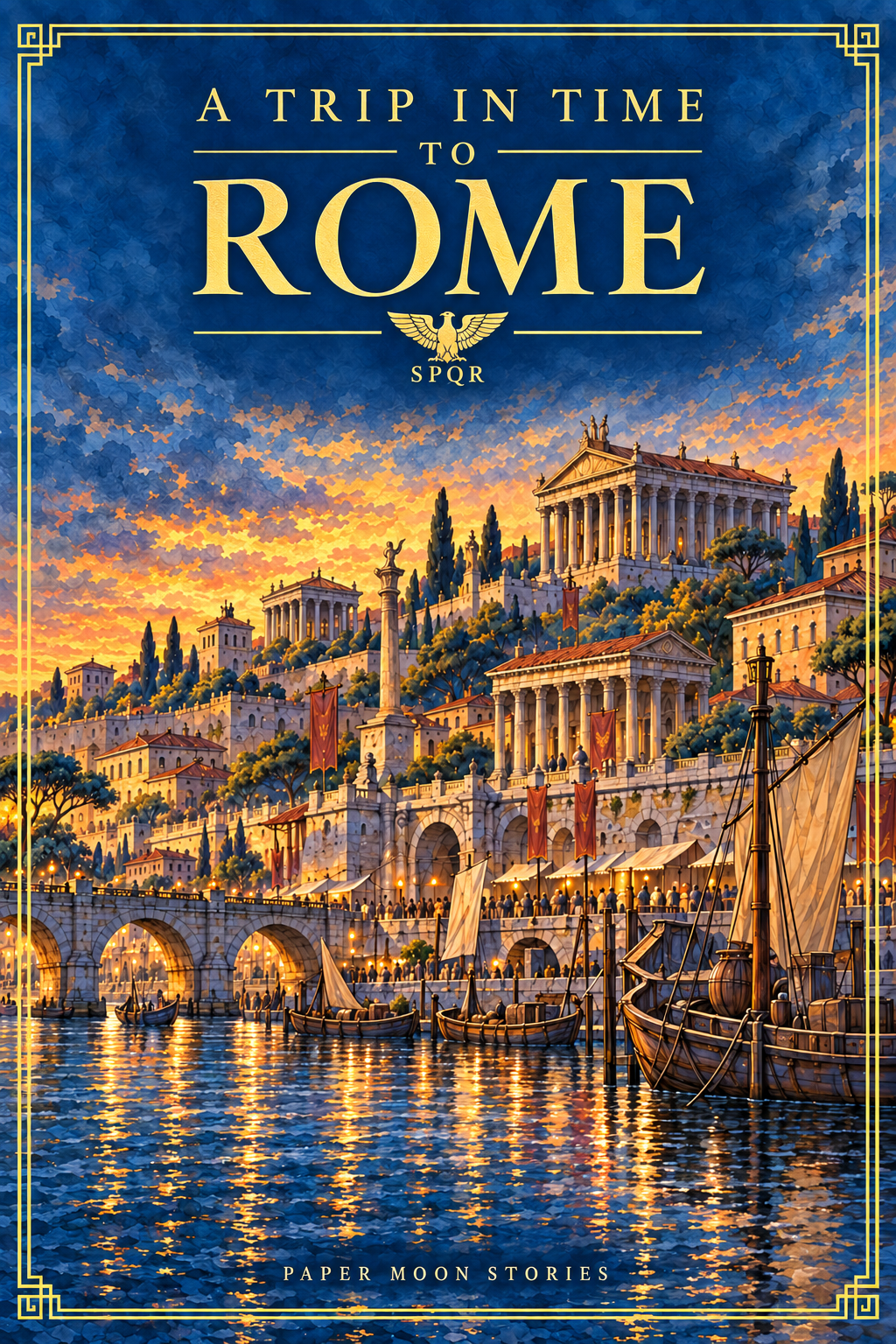
Book One · Ages 12–15
A school assignment. A family journey through time. A city with something to hide.
Discover Rome ↗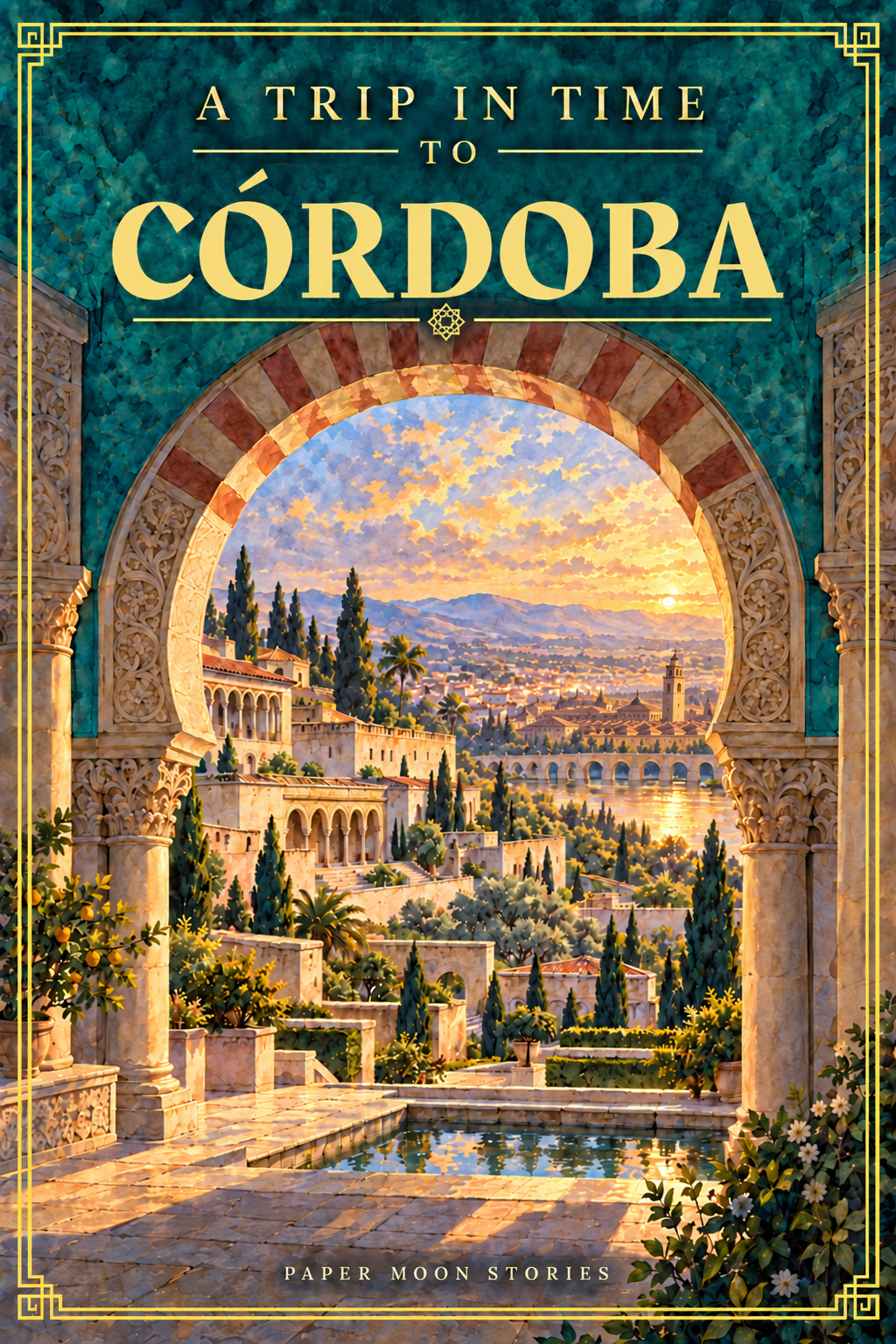
Book Two · Ages 12–15
A family holiday. A magnificent city. A friend who disappears.
You’re here
A Trip in Time · Book Two
Discover Nora’s second adventure in paperback or hardback. Begin with a family that cannot quite agree on what makes a holiday.
A Trip in Time to Córdoba · Paper Moon Stories · Ages 12–15